
Choosing the right honed tube material is critical for hydraulic cylinder performance, service life and total cost. STKM13C, E355 and AISI 4140 are three widely used grades for cylinder barrels. Many buyers get confused when picking between them, because they fit different pressure levels and working conditions. Selecting the wrong tube grade may lead to early leakage, tube deformation or unexpected downtime on your equipment.
Quick overview of each steel grade
STKM13C is a cold drawn carbon steel defined under JIS G3445. After cold drawing and heat treatment, it maintains stable dimensional accuracy and balanced mechanical properties. It suits low-to-medium pressure hydraulic assemblies. You can learn more about its specs in our introduction to STKM13C seamless tube. This grade is frequently requested by clients following Japanese industrial standards for machinery and hydraulic parts.
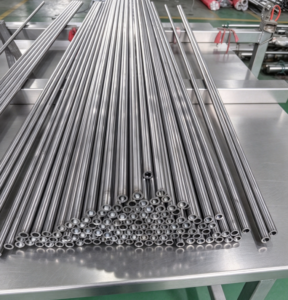
E355, also known as ST52, follows EN 10305. It is a carbon variant with reliable weldability and consistent quality for European markets. Most EU hydraulic OEMs select this as their default option for general medium-pressure builds.
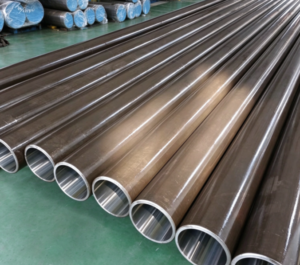
AISI 4140 belongs to chrome-moly alloy steel. Quenching and tempering greatly boost its tensile strength, wear resistance and impact tolerance. It is built for heavy-load, high-pressure hydraulic equipment. We also supply this alloy as 42CrMo4 alloy steel tube. It offers a major upgrade over regular carbon steel when safety and long running cycles are top priorities.
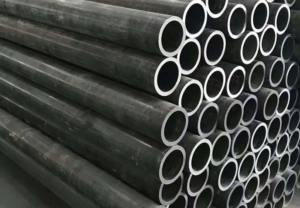 Core performance comparison
The two carbon options share similar base tensile strength values. Still, they follow separate standards, so testing rules and tolerance allowances differ. Both can go through skiving and roller burnishing to reach H8 or H9 inner surface tolerance.
Even so, E355 is more familiar and accepted across EU supply chains, while STKM13C serves projects that require JIS compliance. Neither carbon grade can withstand continuous extreme pressure or heavy repeated shock loads. Exceeding the design pressure will eventually cause permanent yielding.
The alloy grade performs very differently. After heat treatment, it delivers far higher strength and resists deformation under high pressure. It handles frequent pressure spikes that would damage carbon barrels, though it comes with higher material and machining costs.
Cost and lead time difference
For bulk orders, the two carbon options sit at a comparable price range. Their supply chains are mature, and standard sizes are usually stocked with short lead times. They are economical picks for construction, agricultural and material-handling machinery.
The alloy variant costs noticeably more. Heat treatment adds extra production steps, which extends delivery cycles. It is not a practical choice if you have a tight budget and moderate pressure requirements. You will also pay extra for cutting, precision finishing and non-destructive material testing.
Which one should you choose?
Go with STKM13C if your engineering drawing specifies JIS G3445, and your cylinder runs at medium pressure with regular loads. It works well as a replacement part for equipment built around Japanese specifications.
Choose E355 for projects sold into Europe, where drawings reference EN standards. It is the safe, familiar option for local buyers in Germany, France and other EU regions.
Pick the alloy grade only for demanding high-pressure scenarios, such as mining, forestry and heavy waste machinery. These applications often require the extra protection against impact and cyclic pressure.
Surface finish notes
All three grades can be finished for hydraulic use, yet machining workflows vary. Carbon steel workpieces are easy to finish to H8 / H9 tolerance after skiving and burnishing. Their polished inner surface works steadily with standard mineral hydraulic oil.
Alloy steel calls for careful polishing. It supports tight tolerance, but it generates more heat during machining. Operators need sufficient cooling to avoid surface discoloration and micro-cracks.
If your unit works with special fluids or sits in corrosive outdoor environments, inner chrome plating can be added. This finishing works for all three types, but it increases your total expense.
Common risks to avoid
Many buyers only compare steel grades and overlook wall thickness. Even the strongest alloy will fail if the wall is too thin for your working pressure. Always match wall thickness to your cylinder’s rated pressure.
Another frequent mistake is cross-standard substitution. Do not swap between grades without checking your customer’s drawing and certification requirements. Some end users will reject parts that do not match the specified standard.
Final buying tips
Before placing your order, confirm working pressure, impact conditions, required standard and budget. Ask your supplier for MTC documents to verify chemical and mechanical properties. Confirm surface finish, tolerance and plating needs before production starts.
Reference Resources
-
- JSA Japanese Standards Association
- ASTM A519 Specification for seamless mechanical tubing