Selecting a suitable hydraulic cylinder is critical to guarantee stable machine operation, reduce unexpected downtime and cut long-term maintenance costs. Many equipment designers and buyers only focus on load force while ignoring mounting alignment, working environment and seal compatibility. This mistake often causes oil leakage, rod bending or early cylinder failure.
If you have read our previous introduction about hydraulic cylinder basic structure and main components, you already know the core parts of an actuator. Now we will walk you through a practical step-by-step selection process.
Step 1: Calculate Required Force & Working Pressure
Force output is the first parameter to confirm. The thrust of a hydraulic cylinder depends on system pressure and bore area. Always calculate the maximum load and reserve a safety margin of 15–25% for dynamic impact and pressure fluctuation.
The basic formula: Force = Pressure × Effective Piston Area.
- A larger bore delivers greater thrust under the same pressure.
- Remember to check both extension force and retraction force. The retraction force is smaller because the piston rod occupies part of the effective area.
Match your cylinder rated pressure with your hydraulic system. Do not use a cylinder whose rated pressure is lower than the system peak pressure.
Step 2: Confirm Stroke Length & Space Limitation
Stroke defines the linear travel distance of the piston rod. You need to confirm two dimensions:
- Working stroke: the travel your machine requires.
- Retracted length: the overall cylinder length when fully retracted, to fit the limited installation space on your machine.
Do not over-specify stroke blindly. Excessively long stroke increases the risk of piston rod buckling under compression loads.
Step 3: Pick the Correct Cylinder Type
Different cylinder designs fit different working scenarios:
- Tie-rod hydraulic cylinders: Standard industrial type, easy disassembly and maintenance, ideal for stationary industrial machinery.
- Welded hydraulic cylinders: Compact welded barrel structure, high strength, widely used in construction and agricultural heavy equipment.
- Telescopic hydraulic cylinders: Multi-stage design, delivers long stroke while keeping short retracted length, commonly applied to dump trailers and lifting platforms.
You also need to decide between single-acting and double-acting cylinders. Single-acting cylinders provide powered movement in one direction and return by spring or external load. Double-acting cylinders use hydraulic oil for both extension and retraction and offer full control on both strokes.
Step 4: Choose Suitable Mounting Style
The mounting method controls force distribution and prevents harmful side loading. The common mounting options include clevis, flange and trunnion mounts:
- Clevis mount: Pivoting installation, absorbs small misalignment, suitable for moving and swinging loads.
- Flange mount: Fixed and rigid mounting, transfers force along the central axis, for stable push/pull applications.
- Trunnion mount: Pivot around the trunnion pin, good for equipment with swinging motion.
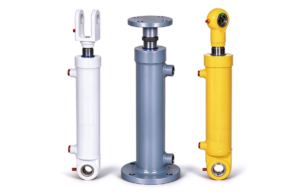
Poor mounting selection creates side load on the piston rod, scratches the chrome surface and rapidly wears rod seals. This is one of the most frequent failure causes.
Step 5: Consider Working Environment & Material
Your operating environment decides the surface coating and seal package:
- Outdoor, dusty sites: Hard chrome plated piston rod, robust dust wiper seals.
- Marine or high-humidity conditions: Extra anti-corrosion treatment.
- High or low temperature: Special seal materials like PTFE or high-temperature polyurethane.
The barrel inner surface finish also matters. Precision honed tube keeps seals intact and reduces internal leakage.
Step 6: Select Seal Package & Port Specifications
Seals stop internal and external oil leakage. Polyurethane, nitrile rubber and PTFE seals serve different pressure, temperature and fluid conditions. Confirm your hydraulic oil type and temperature range before selecting seal materials.
You also need to define port thread standard (BSP, NPT etc.) and port location according to your hose layout.
Common Hydraulic Cylinder Selection Mistakes to Avoid
- Sizing only by extension force and forgetting retraction force requirement.
- Rigid flange mount for applications with swing motion, introducing side load.
- Too long stroke without checking piston rod buckling risk.
- Ignoring dust, corrosion or extreme temperature and using standard seal sets.
- No safety margin reserved for impact load and pressure spikes.
Custom Hydraulic Cylinders from ANBAO
Off-the-shelf cylinders cannot always match your unique machine design. ANBAO supplies welded, tie-rod and telescopic hydraulic cylinders, along with precision honed tubes and chrome piston rods. All products pass strict pressure testing before shipment with ISO9001 & CE certification.
We accept custom orders based on your drawings, samples and special working requirements. Our engineering team helps you select proper bore, stroke, mounting and sealing packages for your project.
If you want technical support or a quotation for custom hydraulic cylinders, feel free to contact us.
Conclusion
Good hydraulic cylinder selection balances force, dimension, mounting and environmental demands. Taking time to specify these parameters reduces equipment breakdown and extends service life.
References
For further reading on fluid power component selection and industry standards, you may refer to these authoritative resources: